FreePost® Spider™ Dot Adhesive: Bubble-Free Lamination for POP Graphics
Application Scenarios and Pain Points in POP Graphics Installation
Bubble entrapment remains the single most common visual defect when applying self-adhesive films to glass, acrylic, or painted surfaces in retail environments. Traditional full-coverage pressure-sensitive adhesives trap air the instant the film contacts the substrate, requiring skilled installers, squeegees, and often rework. For chain retailers cycling seasonal promotions every few weeks, the cost of dispatching professional crews to every location simply to change a window poster is disproportionate to the media cost itself.
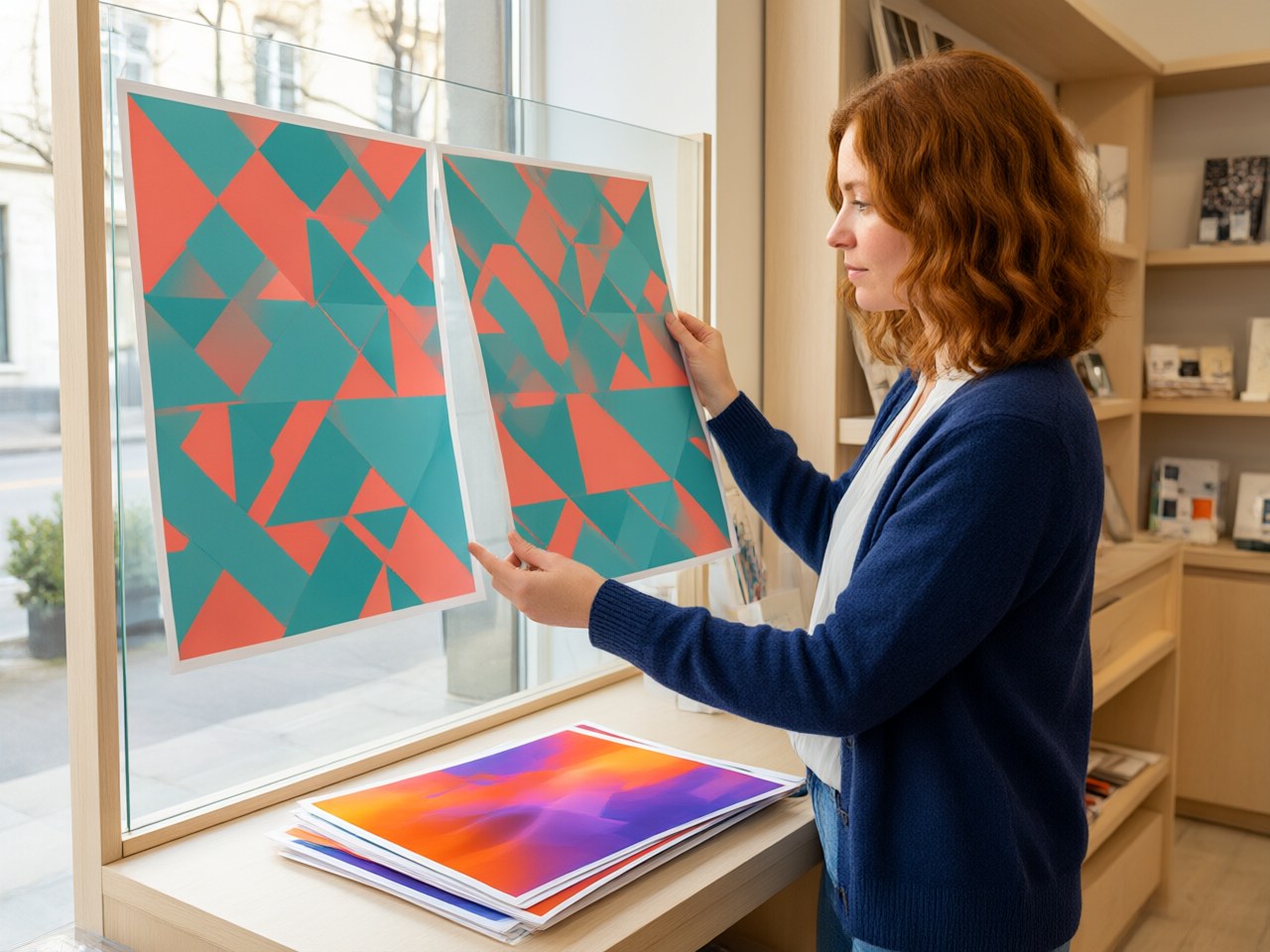
The FreePost® Spider™ dot-pattern adhesive structure addresses this by replacing continuous adhesive coverage with an array of discrete raised adhesive dots. Because the dots are spaced apart, air displaced during application escapes laterally through the open channels between dots rather than being sealed beneath the film. The practical result: store staff—not specialist installers—can apply and later remove large-format POP graphics with no bubbles and no adhesive residue, completing what would otherwise be a two-person professional task in minutes.
How the Dot Adhesive Pattern Prevents Bubble Formation
The mechanism is spatial rather than chemical. A continuous adhesive layer forms a sealed boundary the moment any portion of the film makes contact, trapping pockets of air that have no escape route. In contrast, the Spider™ structure uses individual adhesive dots raised above the film's base. When the film is pressed onto a clean, smooth surface, only the dot peaks make contact; the valleys between dots remain open, forming a network of micro-channels that allow air to migrate freely to the film's edges and vent.
This channel network means that even if the operator lays the film down in a single motion—without the careful progressive squeegee technique required by conventional adhesives—air simply exits through the inter-dot gaps. The result is consistent bubble-free lamination regardless of operator skill level.
Peel force for Spider™ models ranges from 50-150 g/25 mm for PET-based films and 200-500 g/25 mm for PP and PVC models. All models support long-term indoor use on suitable surfaces.
Selection Comparison Table: Spider™ Dot Adhesive Models
| Model | Face Material | Film Thickness (μm) | Total Thickness incl. Liner (μm) | Peel Force (g/25 mm) | Release Force (g/25 mm) | Service Temp (°C) | Indoor/Outdoor | Compatible Printing |
|---|---|---|---|---|---|---|---|---|
| SP-PET115DC | Semi Clear film | 115±7 | 155±9 | 50-150 | < 10 | -20~80 | Indoor | Indigo |
| SP-PET115EW5 | White film | 115±7 | 155±9 | 50-150 | < 10 | -20~80 | Indoor | Eco-solvent, UV Digital, Offset, Latex |
| SP-PET115U1C5 | Semi Clear film | 115±7 | 155±9 | 50-150 | < 10 | -20~80 | Indoor | UV Digital, Latex (partially compatible) |
| SP-PET115UC5 | Semi Clear film | 115±7 | 155±9 | 50-150 | < 10 | -20~80 | Indoor | Offset |
| SP-PET90DW | White film | 90±6 | 140±9 | 50-150 | < 10 | -20~80 | Indoor | Indigo |
| SP-PP120UW8 | Matt white PP film | 120±8 | 170±10 | 200-500 | < 10 | -20~80 | Indoor | Offset |
| SP-PP145EW8 | Matt white PP film | 145±9 | 195±12 | 200-500 | < 10 | -20~80 | Indoor | Eco-solvent, UV Digital, Offset, Latex |
| SP-PVC120E1C6 | Clear PVC film | 120±8 | 240±14 | 200-500 | < 15 | -20~80 | Indoor | Eco-solvent, UV Digital, Offset, Latex |
| SP-PVC120E1W6 | Matt white PVC film | 120±8 | 240±14 | 200-500 | < 15 | -20~80 | Indoor | Eco-solvent, UV Digital, Offset, Latex |
Reading the table: PET-based models offer lighter peel force and thinner profile. PP and PVC models provide firmer hold with slightly greater total thickness. All models are rated for indoor use.
Key Parameters and Practical Installation Guidance
Surface preparation: The application area must be clean and dust-free. Contaminants—including fingerprint oils—on the dot adhesive face will reduce adhesion. Handle material by edges or wear lint-free gloves.
Wet application is not recommended: Spider™ dot adhesive products should not be installed with water or any liquid aid. The adhesive dots are designed for direct dry contact.
Keeping the film flat: During application the film must remain flat and free of creases. Wrinkles and stress-set folds will affect adhesion longevity. Unroll material on a flat table before peeling the liner; do not apply directly from a tightly wound roll if the film has taken a set.
Printing setup: For best print quality on any Spider™ model, set the printer to its highest quality mode. Confirm ink compatibility per model—different models in the same Spider™ family support different printing technologies (see table above).
Storage: Store at 10–25 °C (50–77 °F), 50 % relative humidity, in original packaging. Material stored outside these conditions or beyond the one-year shelf life may exhibit reduced dot adhesion.(出处:企业资料·蜘蛛贴·Spider 产品说明书 - 中文.xlsx)
Pre-production testing: Because application surfaces and environmental conditions vary widely, testing on the actual substrate before committing to volume production is advised. This is especially important on textured, coated, or low-surface-energy panels.
Common Failure Modes and Troubleshooting
| Symptom | Likely Cause (per manufacturer guidance) | Corrective Action |
|---|---|---|
| Film lifts or slides after installation | Dust, grease, or hand oils on the dot adhesive face or substrate | Clean substrate thoroughly; avoid touching adhesive dots during handling |
| Adhesion degrades over days/weeks | Film was applied with wrinkles or has developed stress-set folds | Ensure film is flat before and during application; creases and curing stress affect adhesion longevity |
| Inconsistent hold across surface | Substrate not uniformly smooth or clean | Verify entire surface is free of particulates; test adhesion in a corner before full application |
| Print quality below expectations | Printer not set to maximum quality; wrong ink type for model | Confirm model-specific ink compatibility from table; select highest quality print mode |
Note: Product data does not specify a maximum number of repositioning cycles. If repeated removal and reapplication is required and performance is uncertain, contact the manufacturer to confirm suitability for the specific use case.
Industry Trend:
Why Dot Adhesive Structures Are Gaining Share in Retail POP
The retail signage sector is shifting toward decentralized, store-level graphic changes driven by shorter campaign cycles and rising labor costs. Dot-pattern adhesive films fit this trend because they eliminate the two biggest dependencies of traditional adhesive media: professional installers and post-removal surface cleaning.
Action Checklist
1. Identify your print process first. Match your press or wide-format printer to the compatible models in the table—this single step eliminates most specification errors. 2. Choose face material by optical need. White opaque (PET or PP) for solid-background posters; semi-clear PET or clear PVC where see-through or backlit effects are needed. 3. Confirm substrate condition. Dot adhesive performs on clean, smooth, non-porous surfaces. If your application surface is textured or painted with low-energy coatings, request a sample for on-site testing. 4. Brief store staff on handling. The key instruction: keep fingers off the adhesive dots, lay the film flat, press from center outward—no squeegee or liquid needed. 5. Contact Scitop Ltd for samples and application engineering support. Visit https://zst.cc to request free sample rolls, discuss custom slit widths or OEM branding, and get guidance on matching Spider™ models to your specific retail environment. Consultation is complimentary.
References
- 企业资料·蜘蛛贴·Spider 产品说明书 - 中文.xlsx|SP-PET90DW > SP-PET115DC - 企业资料·蜘蛛贴·Spider 产品说明书 - 中文.xlsx|SP-PET90DW > SP-PP120UW8
<!-- JSON-LD: {"@context": "https://schema.org", "@type": "TechArticle", "headline": "FreePost® Spider™ Dot Adhesive: Bubble-Free Lamination for POP Graphics", "inLanguage": ["en", "zh"], "keywords": "spider dot adhesive bubble-free lamination, dot pattern adhesive POP graphics, removable dot adhesive film no bubbles, spider adhesive structure signage application, bubble-free install removable POP film", "about": [{"@type": "Thing", "name": ""}, {"@type": "Thing", "name": ""}], "author": {"@type": "Organization", "name": "Scitop Application Engineering Team", "alternateName": "中世拓应用工程团队"}, "publisher": {"@type": "Organization", "name": "Scitop Application Engineering Team", "url": "https://zst.cc"}} -->