Republished by Scitop Ltd. All rights belong to the original publisher; see Source below.
HP is looking to boost the life and appeal of its R-series hybrid Latex printers in rigid media applications with the introduction of an automated feeder/stacker that aims to improve overall productivity from loading to output. Michael Walker joins the queue
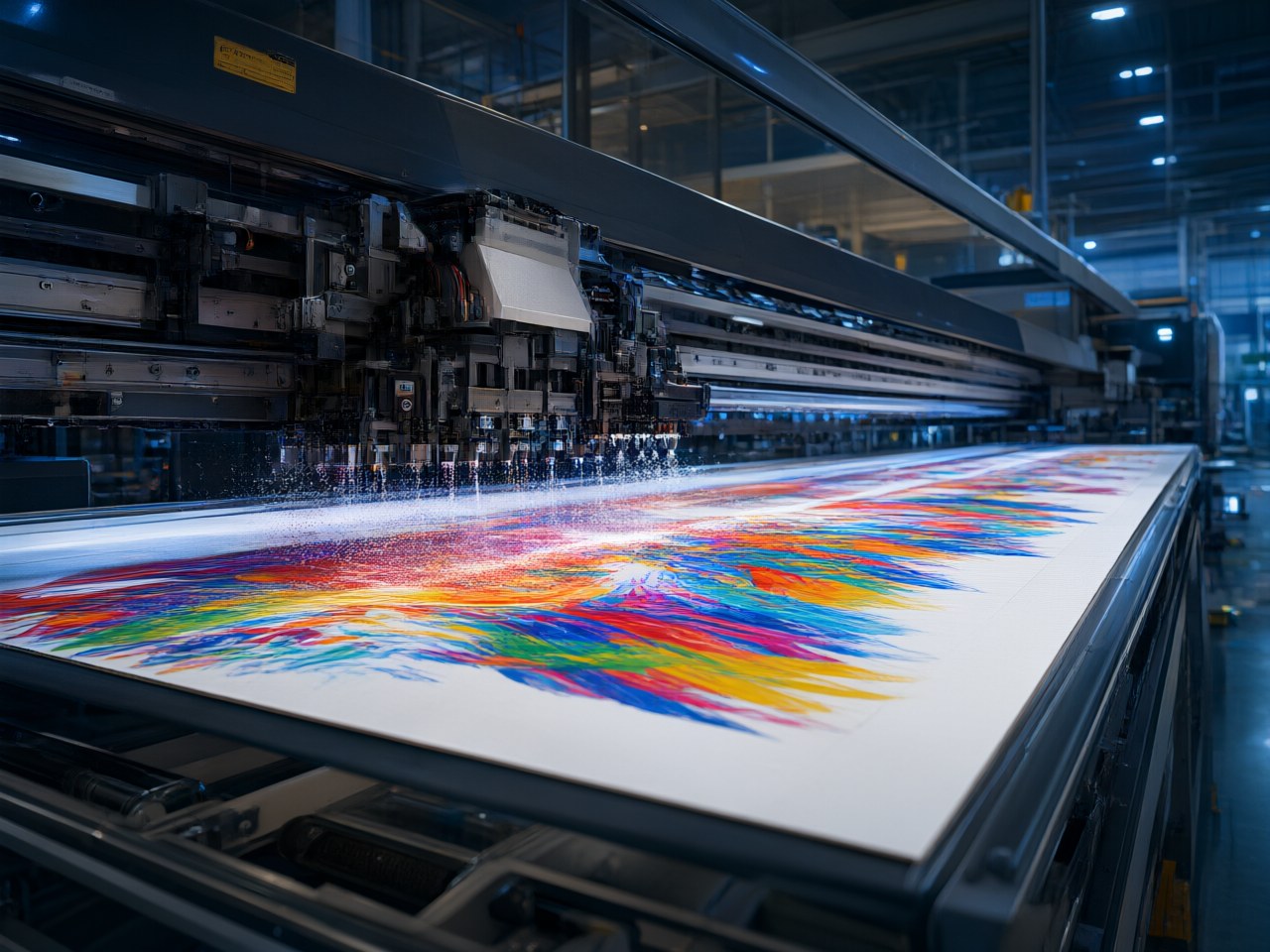
Along with UV and solvent/eco-solvent, HP Latex is one of the well-established wide-format digital printing ink technologies that most printers or sign-makers will consider when contemplating a new purchase for flexible media.
HP has established a solid position in flexible roll media printing with its water-based ink series of printers since their introduction in 2008, but for the first decade of the technology’s life, the company didn’t have an offering for rigid media print. Rather than attempt to compete in the already well-populated flatbed space, the company chose to go the hybrid route, with the introduction in 2018 of the R2000, a 2.5m width machine that with the addition of tables and feed mechanisms allowed the Latex inks to be printed onto a range of rigid media.
A smaller sibling, the 1.6m wide R1000, appeared later the same year and both models were refreshed with ‘Plus’-designated versions in 2020. A new and smaller footprint option for customers for whom the 1.6m width was sufficient appeared in 2025, in the form the of HP Latex R530 (profiled in the Print Monthly July/August 2025 issue). The R530 was intended to bring a smaller footprint, aimed at small-to-medium print service providers (PSPs) who currently lack any rigid printing capability and who may be using mount-and-laminate solutions for rigid substrates. It was also targeted at larger sites with older flatbeds whose print quality is now below market expectations, and even as a high-quality companion in larger sign shops or potentially for offset printers looking to buy a first digital printer.
The major strength of HP’s Latex ink is that it is water-based, which allows its use in applications where UV is not accepted, such as interiors in schools and hospitals. The inks have various health/environmental certifications, including Greenguard Gold and EcoLogo, and the nature of the dried ink is such that the underlying texture of the substrate is preserved, which can be an attractive extra on materials such as wood.
The downside of being water-based is that more energy is required to dry the ink than to cure UV. HP has continued to develop and refine its Latex inks over several generations, reducing the energy consumption along the way. In the R530, ten printheads allow for the usual CMYK plus light cyan and magenta, white, an optimiser (primer), and protective Latex Overcoat for scratch and scuff resistance. Supporting resolutions up to 1200 x 600dpi, HP says the R530 will provide the same quality on all media, whether flexible or rigid.
Extending the Appeal
However, HP isn’t the only vendor which can offer hybrid roll-based printers: Agfa, EFI, Durst/Vanguard, and ColorJet are just some of the alternatives, and the company admits that its machines aren’t the fastest in comparison to others. However, raw print speed alone is only part of the overall productivity equation. While roll media can be loaded and largely left to run, rigid boards and similar need to be fed in and taken off the printer as each is completed.
That typically doesn’t quite happen fast enough to warrant people standing either side all the time, just loading and unloading, while having one person doing both will create intense bursts of activity between each board or sheet – and yet is likely to introduce delays between removing one and loading the next as the same person can’t be both sides of the machine at once – but still with unproductive waiting time in between that isn’t really long enough to do much of anything else. With labour costs rising constantly and the availability of suitably skilled staff apparently dropping in inverse ratio, it’s increasingly impractical and expensive to dedicate staff to tasks like these.
The answer, of course, is automation. While robotic load and unload systems have been an option for the fastest flatbed printers for some years, they’ve been very much the high-end option for the biggest print shops with very large volumes. What HP has done in conjunction with Italian post-print finishing specialist, Neolt, is to come up with an automation option for HP’s R-series hybrid printers that is an appropriate match for the printers’ throughput.
Shown working in conjunction with a Latex R2000 at FESPA 2026 in Barcelona, and available in the UK through exclusive reseller Papergraphics, Neolt’s Automatic Feeder and Stacker for R-Series brings some of this capability to much smaller enterprises, bringing automated feeding and stacking capabilities to all the R-series models, including the R530, both new and in existing installations. This allows for unattended operation and what HP describes as a ‘significant’ productivity increase for work on pre-cut rigid boards.
The Neolt unit’s loading and unloading tables can hold up to 40cm depth of material, and there is an automatic levelling system that adjusts height according to material quantity for optimal alignment and performance.
The loading system uses a vacuum suction cup unit with independent motion control, allowing precise and automated sheet feeding directly to the printer. The stacker system features pneumatic motorised rollers for smooth panel ejection and is open to integration with cutting systems as well. The configuration suitable for use with the HP Latex R530 and R1000 can handle media up to 1600 x 1500mm, while the model for the R2000 goes to 2500 x 1600mm, so big enough for the standard 8 x 4ft board format if you have the larger Latex printer, with optional extension tables for both formats available.
HP says it’s suitable for paper-based materials, self-adhesive vinyl, roll-ups and boards, including corrugated plastic types, Plexiglass, Dibond/aluminium, various foam boards, paperboards, and cardboard. Media under 180gsm or heavily wrapped cardboard are not recommended. At the other end of the scale, media loading capacity for up to 400kg means that some quite dense materials can be handled. Papergraphics confirms guide pricing at under £40,000 for the 1.6m configuration for use with the HP Latex R1000 and R530 models, and under £50,000 for the 2.5m version to suit the Latex R2000.
The Neolt Feeder and Stacker will be on display at The Print Show in September with HP presenting it running in conjunction with the Latex R1000 Plus printer, so you will have a chance to assess its capabilities in the flesh at the show.
Statistics Maximum Media Weight: 400kg Maximum Media Size: 1600 x 1500mm (R1000 and R530 version); 2500 x 1500mm (R2000 version) Media Capacity (Height of Stack): 40cm Input Feed: Via suction cup with independent placement Output Feed: Pneumatic motorised rollers
Source
- SignLink (2026-08-17) - Original article: Finding the Right Configuration