Glossy Photo Paper Reflects Strongly—How Should Showroom Lighting Work With It?
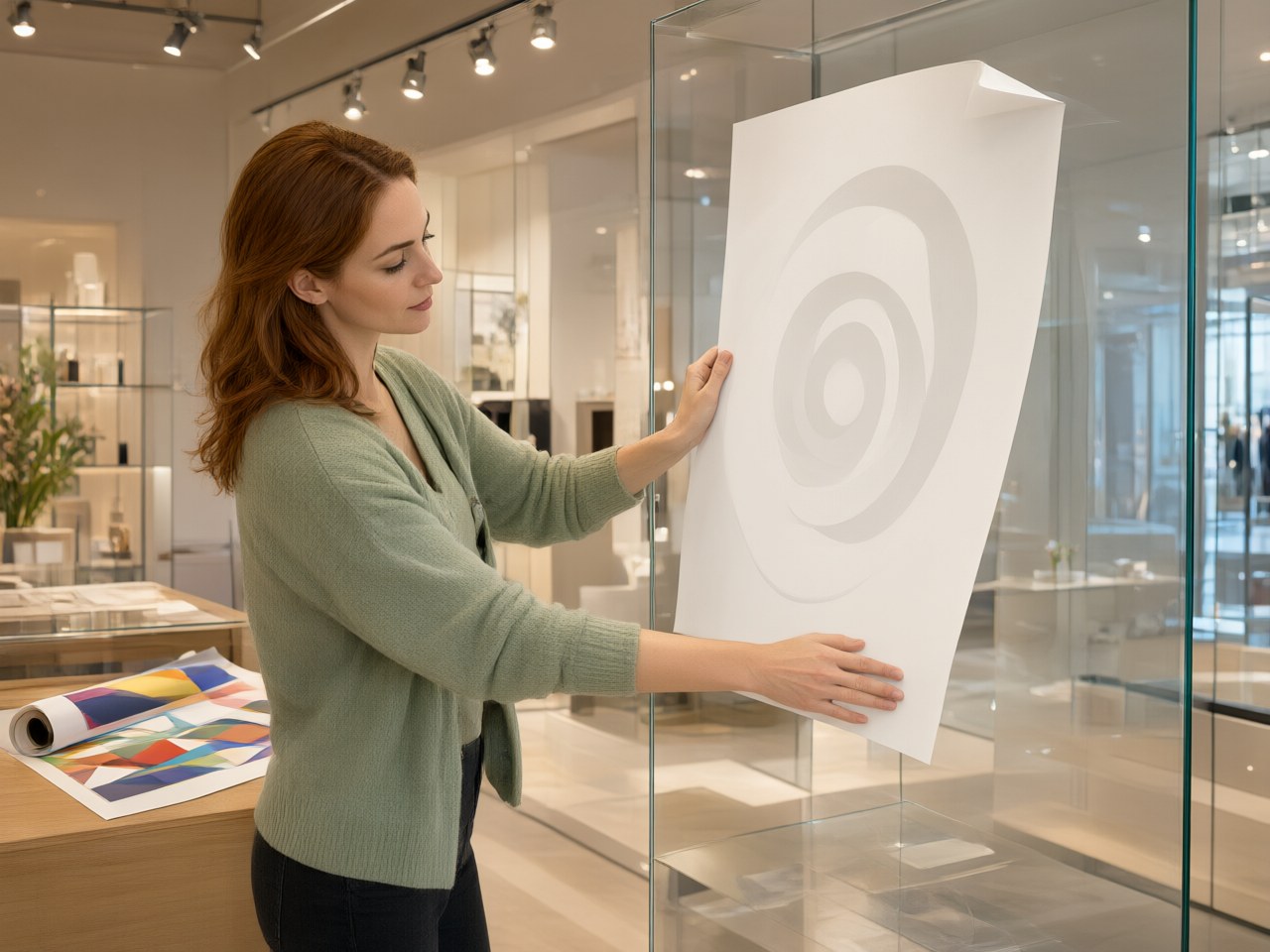
Glossy photo paper produces a clear specular reflection, so showroom lighting should send that reflection away from visitors' eyes. Mount spotlights close enough to the wall that they strike the print at a steep angle, about 30° from vertical, and keep bright windows, light boxes and exposed lamps out of the zone opposite the print. Where the room geometry cannot be changed, use a semi-gloss or matte print on that wall and keep full gloss for prints you can light at a steep angle. A glossy print that is lit correctly shows the high contrast and depth it was chosen for. A badly lit one shows a white hotspot in the middle of the image.
Why Glossy Prints Show Glare
A glossy surface returns a concentrated specular reflection, and the outgoing angle matches the incoming angle. A visitor standing on that path sees a bright image of the lamp or window on top of the picture. A matte surface scatters light, so no single viewing position collects a hotspot.
That is the practical difference between the two photo-paper families from Dongguan Zhongshitou Industrial Co., Ltd. The ZST glossy photo paper range has a bright high-gloss surface optimized for dye-ink inkjet printing, and it delivers high-contrast, photographic-quality output for portraits, promotional prints and art reproduction. ZST matte photo paper is made on a 100% wood-pulp base and has a non-reflective, glare-free finish, which suits work viewed under mixed light. Gloss delivers that contrast when the light is placed with care. When a bright source sits on the mirror path through eye height, the print shows a hotspot; a steeper aim, or a semi-gloss or matte sheet on that wall, clears it.
Showroom Hotspot from a Shallow Lamp Angle
A lamp set far from the wall can throw the reflection of a glossy print into adult eye height.
Example room only. The dimensions are worked values, not a measured installation.
A showroom hangs a row of large glossy portraits. Each print is about 1.2 m tall, with its centre at 1.6 m. The ceiling is 3.0 m high, and the track is at ceiling height. The track lighting runs 2.5 m out from the wall because it was positioned for the merchandise tables. The faces at the top of the prints disappear into glare.
The cause is geometry:
- Lamp 2.5 m out, aimed at the top edge (2.2 m high). The beam drops 0.8 m over 2.5 m of horizontal distance, so it arrives at a shallow angle of roughly 72° from vertical. It reflects downward at the same angle. At 1.5 m from the wall, where visitors stand, the reflection has dropped only about 0.5 m, to roughly 1.7 m. That is adult eye height, so the glare lands in their eyes. - Lamp moved to 0.8 m out, aimed at the print centre. The beam drops 1.4 m over 0.8 m, which is roughly 30° from vertical. The reflection leaves at that same steep angle and reaches the floor about 0.9 m in front of the wall, below a standing visitor's eye line.
The practical fix is a second track run about 0.8 m from the wall, dedicated to the prints. For this ceiling-to-centre height difference of 1.4 m, an offset of about 0.55–0.6 times that difference lands near 30° from vertical and gives the 0.8 m used here. The bigger the print, the more the top edge matters. Check that edge separately, because it is the part that sends reflections toward eye level.
Lighting Setups Compared for Glossy Prints
A steep aim sends the reflection to the floor. A shallow aim, or a bright source opposite the print, puts glare in the image.
| Setup | Effect on glossy prints | When to use |
|---|---|---|
| Spot or track lamp about 30° from vertical, close to the wall | Reflection goes to the floor and the print reads cleanly | Default for most standing-height displays |
| Lamp far from the wall (shallow angle) | Glare at eye height, especially on the upper part of large prints | Avoid it, or move the track |
| Lamp behind or above the viewer | Hotspot near the centre of the image | Avoid it |
| Wide diffuse ceiling panels or large softboxes | Larger, dimmer veil of reflection that lowers perceived contrast | Fine for small prints; check large glossy panels on site |
| Window or light box opposite the print | Visible mirror image of the bright area on the print | Re-hang the print, block the source, or switch to matte |
| Framed under glazing | A second reflective layer sits on top of the paper's own gloss | Apply the same angle rules to the glazing |
Choosing the Paper Surface for the Room
Pick the finish after checking the light. Some walls cannot be lit at a good angle. The ZST glossy photo paper family has four variants, so the gloss level can be matched to the wall.
| Product | Surface | Basis weight (gsm) | Ink compatibility | Formats |
|---|---|---|---|---|
| Glossy photo paper SE6 | Single-side high gloss | 108–300; also listed 120–300 | Optimized for dye ink | Series formats: A4/A3 sheets; 610 / 914 / 1067 mm rolls |
| Glossy photo paper DE6 | Double-side high gloss | 108–300; also listed 120–300 | Optimized for dye ink | Series formats: A4/A3 sheets; 610 / 914 / 1067 mm rolls |
| Glossy photo paper E3 | Semi-gloss | 108–300; also listed 120–300 | Optimized for dye ink | Series formats: A4/A3 sheets; 610 / 914 / 1067 mm rolls |
| Glossy photo paper GJ | High gloss, adhesive-backed | 108–300; also listed 120–300 | Optimized for dye ink | Series formats: A4/A3 sheets; 610 / 914 / 1067 mm rolls |
| R-Glossy (RC) | Resin-coated, high gloss | 200 / 220 / 240 / 260 | Water-based dye and pigment ink | Sheets; rolls 305 / 432 / 610 / 914 / 1118 / 1270 / 1520 mm; indoor; two-year shelf life |
| ZST matte photo paper | Glare-free matte, 100% wood pulp | 120–320 | Dye and pigment ink | Single-side, double-side and adhesive-backed; custom sizes |
R-Glossy lists water-based dye and pigment ink, and ZST matte photo paper lists dye and pigment ink. The glossy photo paper family is optimized for dye-ink inkjet. Dongguan Zhongshitou Industrial Co., Ltd. coats and slits these papers on lines with more than 20 years of inkjet-media production.
On-Site Checks Before Opening Day
Run these checks with the final prints in place and every light source switched on, including daylight at the time of day visitors will come:
1. Stand where a typical visitor stands, then crouch to child or wheelchair eye height, and look at the top, centre and bottom of each print. Any bright lamp or window image you see there is a hotspot visitors will see too. 2. Walk the room diagonally. Large glossy prints can pick up a reflection at an angle even when they look clean straight on. 3. Look for bright surfaces opposite the prints, such as windows, illuminated signage, light boxes and white walls under strong light. Glossy paper will mirror them. 4. Re-aim one lamp at a time before changing brightness. 5. If a wall still shows glare, reprint those images on E3 semi-gloss or on ZST matte photo paper.
Action Checklist
Settle the aiming angle, the sources opposite the print, and the paper finish before opening day.
- Measure the ceiling height, the height of each print centre and the track distance from the wall, then confirm the aiming angle is close to 30° from vertical. - Check the top edge of every large print separately from its centre. - Remove, block or relocate bright sources directly opposite glossy prints. - Match paper to ink: ZST glossy photo paper for dye-ink systems, and R-Glossy or ZST matte photo paper for pigment workflows. - Choose high gloss where the aiming angle can be held near 30° from vertical. Use E3 semi-gloss or matte on walls where the track and opposite sources cannot be moved. - Before ordering, print and hang a test panel under the actual showroom lights. Visit https://www.scitop.net to contact Scitop Ltd for application engineering advice, sample support and OEM/ODM paper in your own sizes, roll widths and brand packaging.
References
1. Illuminating Engineering Society (IES). The Lighting Handbook, museum, gallery and display lighting. 2. Scitop Ltd. ZST glossy photo paper, models SE6, DE6, E3 and GJ. https://www.scitop.net 3. Scitop Ltd. ZST matte photo paper. https://www.scitop.net 4. Scitop Ltd. R-Glossy RC photo paper. https://www.scitop.net